Bernard Law Montgomery
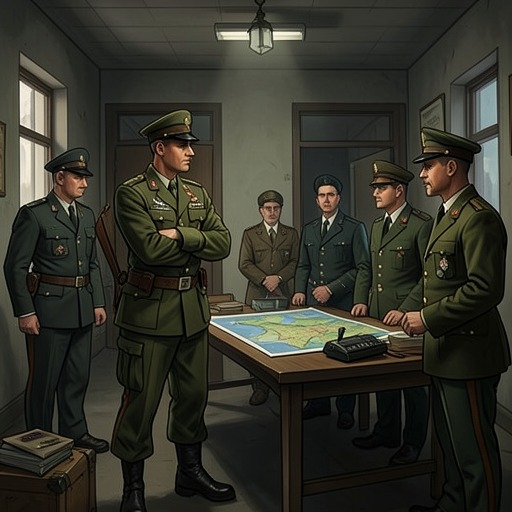
Across the River and into the TreesBernard Law Montgomery is presented indirectly, through Richard Cantwell’s recollections and judgments rather than through a scene in which Montgomery appears. In this portrait, his reputation as a celebrated commander clashes with Cantwell’s skeptical account of his pace, operational performance, and public self-presentation. The result is less a comprehensive biography than a revealing measure of Cantwell’s distrust of military celebrity and rear-command authority.
Identity and Introduction
Montgomery enters the conversation when Renata asks Cantwell about celebrated Allied commanders. Cantwell dismisses the assumption that Montgomery was a great general, describing him instead as a commander who required overwhelming numerical superiority before moving and then moved late. The assessment is deliberately sharp: it presents Montgomery as cautious to the point of delay, but it remains Cantwell’s verdict, not an independently established account of Montgomery’s character or record.
Cantwell’s phrasing also makes the judgment personal without making it a claim of hatred. Asked whether he disliked Montgomery, he says he does not; he simply regards him as a British general, a label he warns Renata against using. The exchange leaves the label pointedly unexplained, allowing Cantwell’s national and professional skepticism to show without turning it into a fuller argument.
Military Reputation and Public Image
To support his view, Cantwell recalls seeing Montgomery arrive at a hotel in his proper uniform, change into conspicuous clothes intended to attract a crowd, and go out to animate the populace. The anecdote places public performance beside military command: in Cantwell’s telling, Montgomery appears attentive not only to operations but also to the effect he makes on civilians. The contrast helps explain why Cantwell distrusts the popular image of the great general, though the scene is reported solely from his perspective.
That skepticism is consistent with Cantwell’s own emphasis on practical combat experience. He recalls commanding troops under sustained attack and insists on the work of teaching soldiers to shoot and keeping count of those still able to fight. The novel does not establish this as an objective standard by which Montgomery’s career can be judged; rather, it sets Cantwell’s close, bodily knowledge of combat against the distance and ceremony associated with senior command.
Paris, Falaise, and the Allied Plan
Montgomery is also invoked in Cantwell’s account of the Allied plan for Paris. Cantwell says the French had taken the city four days earlier, while the Supreme Headquarters Allied Expeditionary Force had devised an encirclement plan that meant the Allies could not simply enter and take it. He adds that they had to wait for the possible arrival of Montgomery, whom he blames for failing to close the Falaise Gap and for not getting there in time.
The episode gives Cantwell’s criticism operational stakes: delay and planning at the highest level, as he recounts them, affected what the forces in the field could do. But the novel presents the explanation through Cantwell’s retrospective account, colored by his contempt for military politicians and grand plans. It does not provide Montgomery’s response or an independent account that would settle responsibility.
Narrative Role
Montgomery’s brief appearances in conversation sharpen the novel’s contrast between command as public reputation and command as lived responsibility. Cantwell’s account of changing clothes for a crowd sits beside his own memories of combat, casualties, and orders that overruled what he believed the situation required. Montgomery consequently serves as a figure through whom Cantwell articulates his suspicion of celebrated leadership and delayed decision-making.
The portrait remains deliberately limited. Montgomery is not given a direct voice, an interior life, or a scene from his own perspective; readers encounter him through Cantwell’s criticism, including its wit and national shorthand. That limitation matters: the character’s significance lies not in a balanced biography, but in what Cantwell’s account reveals about the narrator of these recollections—his impatience with command at a distance and his insistence that reputations be measured against consequences in the field.